Note: Page 65 is blank.

The Guangzhou Intellectual Property Court ruled seven defendants liable for "virtual digital human" trade secret infring...

The Supreme People's Court ruled that patentees with valid patents and positive evaluation reports fulfill duty of care,...
Contents
Foreword
I. Overview of Intellectual Property Procuratorial Work
1. IPR Criminal Procuratorial Work
2. IPR Civil Procuratorial Work
3. IPR Administrative Procuratorial Work
4. IPR Public Interest Litigation Procuratorial Work
II. Focusing on the Core Mission, Serving High-Quality Economic and Social Development
1. Serving the Development of New Quality Productive Forces
2. Stimulating Cultural Innovation and Creativity
3. Supporting the Implementation of National Brand Strategy
4. Strengthening Judicial Protection in Key Areas
5. Fostering a Law-Based Business Environment
III. Coordinating Efforts to Build an Overall IPR Protection Framework
1. Promoting the Improvement of a Coordinated IPR Protection System
2. Establishing and Improving a Cross-Regional Procuratorial Protection System
3. Actively Building a Foreign-Related Procuratorial Work System
IV. Consolidating and Further Deepening Comprehensive Procuratorial Performance
1. Deepening Comprehensive Procuratorial Performance and Consolidating the Foundation for High-Quality and Efficient Case Handling
2. Implementing the Strategy of Strengthening Procuratorial Work through Talent and Advancing Specialized Team Capacity Building
3. Carrying out Diverse Legal Publicity and Education, Telling the Story of Procuratorial Work in the New Era
Conclusion
Foreword
In 2025, with the approval of the central authorities, the Supreme People's Procuratorate (SPP) officially established the Intellectual Property Procuratorial Department. This demonstrates the great importance the Central Committee of the Communist Party of China (CPC) attaches to intellectual property protection and marks a further step toward the specialized and integrated development in the judicial protection of intellectual property by China's procuratorial organs. Guided by Xi Jinping Thought on Socialism with Chinese Characteristics for a New Era, procuratorates at all levels across the country thoroughly implement Xi Jinping Thought on the Rule of Law, earnestly carry out the decisions and arrangements of the CPC Central Committee on strengthening intellectual property protection, as well as the work requirements of the Party Leadership Group of the SPP. We continue to strengthen professional capacity building, further advance the integrated performance of intellectual property procuratorial functions, effectively serve the national strategy for innovation-driven development, and actively foster a first-rate, market-oriented and law-based business environment that aligns with international practice. These efforts contribute procuratorial strength to the successful conclusion of the 14th Five-Year Plan and the high-quality economic and social development of the country.
I. Overview of Intellectual Property Procuratorial Work
In 2025, people's procuratorates at all levels lawfully and comprehensively performed the procuratorial functions in criminal, civil, administrative, and public interest litigation concerning intellectual property rights (IPR), adhering to the fundamental value pursuit of handling every case with high quality and efficiency, and "striving to ensure that the people feel fairness and justice in every judicial case". We ensured equal protection of the lawful rights and interests of all types of business entities in accordance with the law, leading to steady improvements in the quality and effectiveness of supervision and case handling.
1. IPR Criminal Procuratorial Work
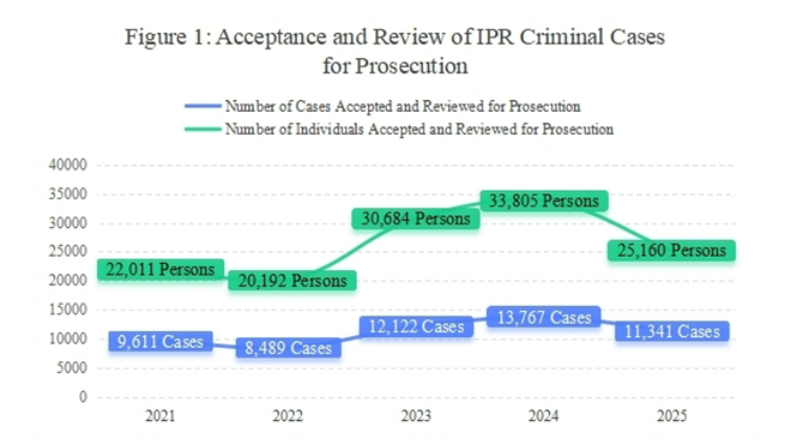
Procuratorates at all levels fully and accurately implemented the criminal policy of tempering justice with mercy and cracked down on IPR infringement crimes in accordance with the law. We accepted and reviewed 6,220 cases for approval of arrest involving 10,509 persons, approved the arrest of 5,709 persons in 3,781 cases, and disapproved the arrest of 4,666 persons; accepted 11,341 cases involving 25,160 persons for prosecution, initiated prosecution in 9,135 cases involving 19,102 persons, and decided not to prosecute 5,105 persons.
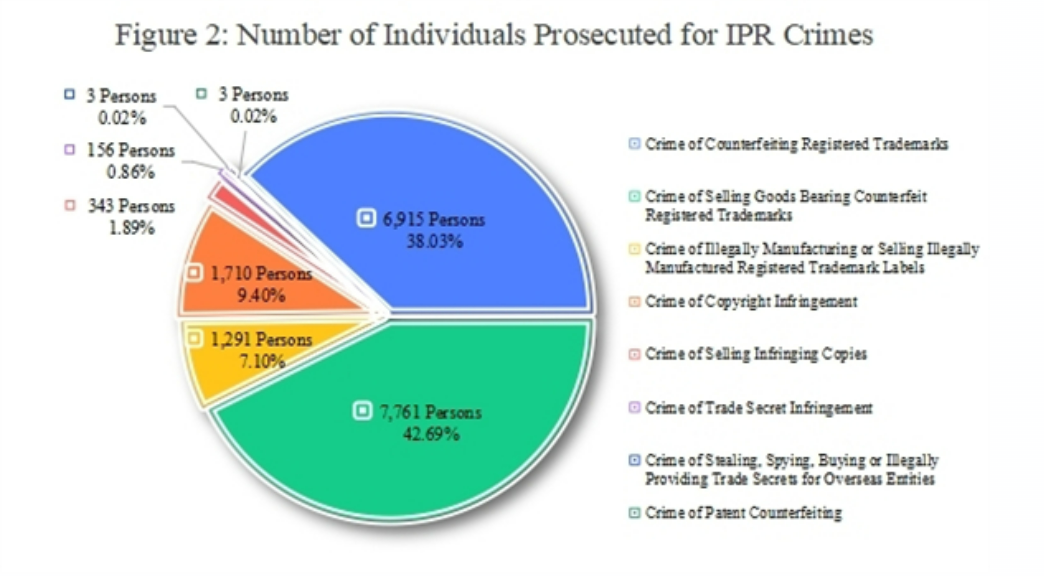
1.1 Cracking Down on All Types of IPR Infringement Crimes in Accordance with the Law. Procuratorates approved arrests in 1,461 cases involving 2,273 persons suspected of the crime of counterfeiting registered trademarks, and prosecuted 3,255 cases involving 6,915 persons; approved arrests in 1,439 cases involving 2,079 persons suspected of the crime of selling goods bearing counterfeit registered trademarks, and prosecuted 3,743 cases involving 7,761 persons; approved arrests in 197 cases involving 259 persons suspected of the crime of illegally manufacturing or selling illegally manufactured registered trademark labels, and prosecuted 519 cases involving 1,291 persons; approved arrests in 246 cases involving 368 persons suspected of the crime of copyright infringement, and prosecuted 894 cases involving 1,710 persons; approved arrests in 70 cases involving 90 persons suspected of the crime of selling infringing copies, and prosecuted 162 cases involving 343 persons; approved arrests in 40 cases involving 89 persons suspected of the crime of trade secret infringement, and prosecuted 71 cases involving 156 persons; prosecuted 2 cases involving 3 persons suspected of the crime of stealing, spying, buying, or illegally providing trade secrets for overseas entities; approved arrests in 2 cases involving 2 persons suspected of the crime of patent counterfeiting, and prosecuted 1 case involving 3 persons.
1.2 Carrying out Case-Filing Supervision and Investigative Supervision. Procuratorates recommended, in accordance with the law, that administrative authorities transfer 198 cases involving 211 persons suspected of criminal offenses. We supervised public security organs to file 272 cases and dismiss 538 cases. For IPR infringement crimes, rectified failure to approve arrest (113 persons) and failure to prosecute (787 persons). Issued 947 written notices of correction to public security organs for illegal investigative activities. Implemented the mechanism for public security organs to seek opinions from procuratorates in major and difficult cases, and legally intervened in 1,556 cases to guide evidence collection.
1.3 Strengthening Criminal Trial Supervision. Procuratorates conducted legal supervision over criminal judgments and rulings in accordance with the law and initiated 71 protests with the people's courts. We strengthened supervision over illegal activities in criminal trials and issued 135 written opinions of correction to the people's courts, a year-on-year increase of 95.7%.
1.4 Implementing the System of Leniency for Pleading Guilty and Accepting Punishment. At the stage of review and prosecution, procuratorates applied the leniency system to conclude 8,784 cases involving 18,570 persons for IPR crimes, with an application rate of 85.3%. Made specific sentencing recommendations for 15,252 persons, of which 14,697 were adopted by the people's courts, an acceptance rate of 96.4%.
1.5 Punishing Online IPR Infringement Crimes in Accordance with the Law. Among the prosecuted IPR criminal cases, 3,408 cases involved commission via the internet, accounting for 37.3%. Some cases formed a contactless criminal chain integrating production, sales, order placement, and delivery, which increased the difficulty of cracking down on such crimes.
2. IPR Civil Procuratorial Work
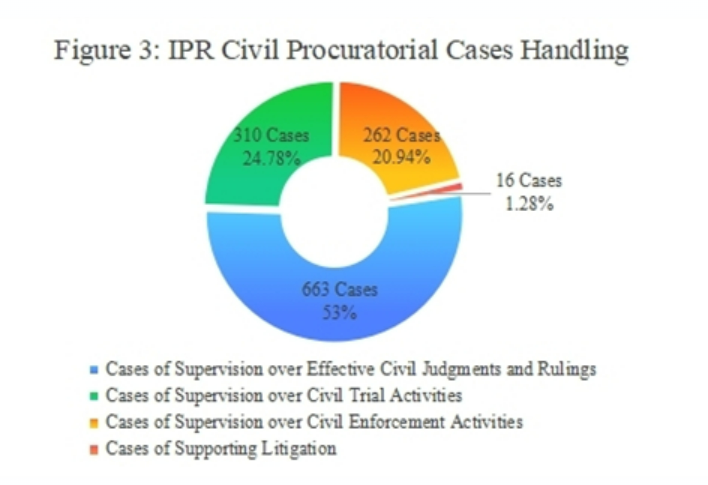
Procuratorates at all levels handled 1,251 IPR civil procuratorial cases, including 663 cases of supervision over effective civil judgments and rulings, 310 cases of supervision over civil trial activities, 262 cases of supervision over civil enforcement activities, and 16 cases of supporting litigation.
2.1 Advancing Supervision over Effective Civil Judgments and Rulings. Procuratorates issued 433 supervisory opinions on effective civil judgments and rulings in IPR cases, including 41 protests and 392 procuratorial recommendations for retrial. The people's courts concluded 272 cases and reversed 270 judgments after retrial.
2.2 Strengthening Supervision over Civil Trial Activities. Procuratorates issued 277 procuratorial recommendations against illegalities in civil trial procedures in IPR cases, a year-on-year increase of 24.2%, and the people's courts adopted 277 recommendations (including those from previous years).
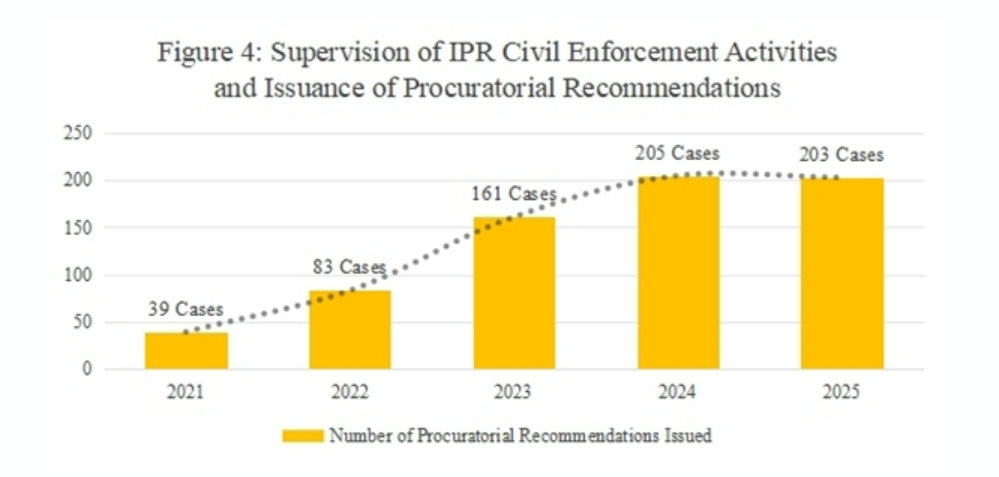
2.3 Carrying out Solid Supervision over Civil Enforcement Activities. Procuratorates implemented the requirement for full-process supervision of civil enforcement activities, issued 203 procuratorial recommendations to the people's courts, of which 196 were adopted, an acceptance rate of 96.6%.
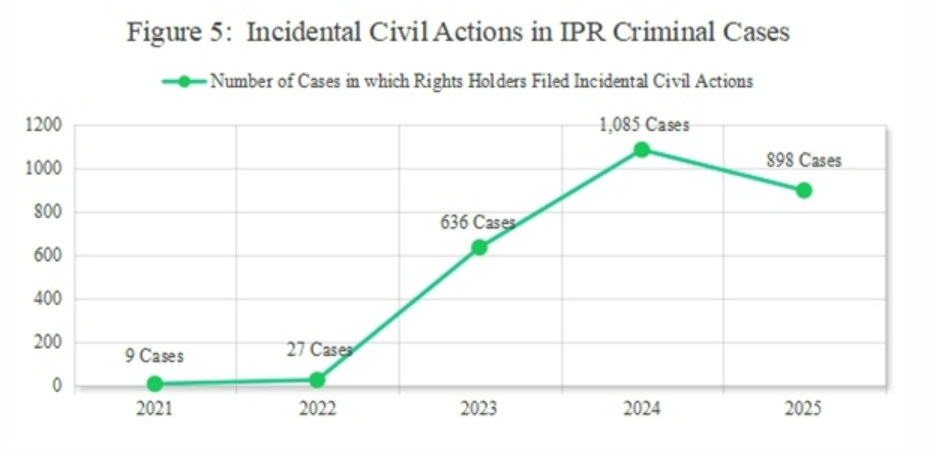
2.4 Promoting Incidental Civil Actions in IPR Criminal Cases. In the prosecuted IPR criminal cases, procuratorates ensured that rights holders filed 898 incidental civil actions, accounting for 9.8%, effectively reducing the cost of rights protection and alleviating the burden of litigation on rights holders.
3. IPR Administrative Procuratorial Work
Procuratorates at all levels handled 1,795 IPR administrative procuratorial cases, including 228 cases of supervision over effective administrative judgments and rulings, 10 cases of supervision over administrative trial activities, 24 cases of supervision over administrative enforcement activities, and 1,533 cases of reverse transfer between administrative enforcement and criminal justice.
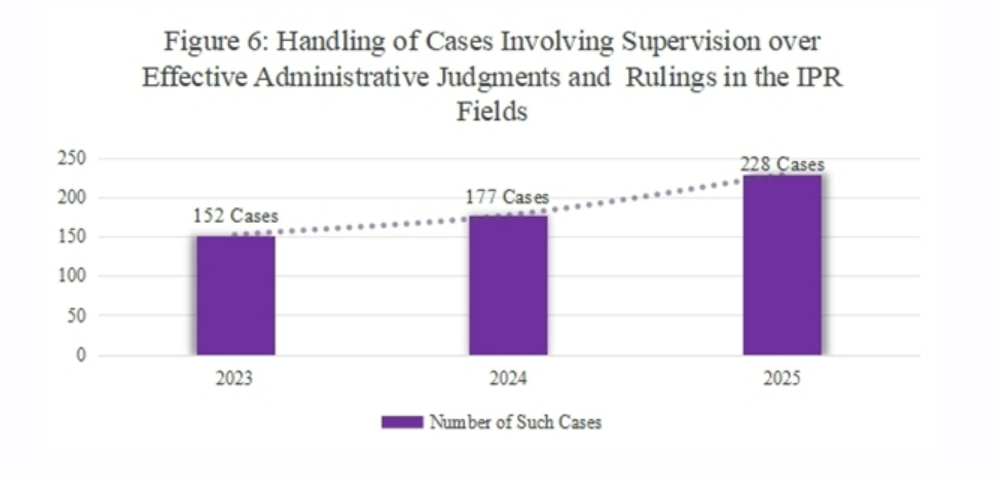
3.1 Strengthening Supervision over Effective Administrative Judgments and Rulings. Procuratorates handled 228 cases of supervision over effective administrative judgments and rulings in the IPR fields, a year-on-year increase of 28.8%. Among these, 181 cases involved trademarks, 31 involved patents, 12 involved monopolies, and 4 involved other IPR fields.
3.2 Promoting Supervision over Administrative Trial Activities and Enforcement Activities. Procuratorates handled 34 cases of supervision over administrative trial activities and administrative enforcement activities in the IPR fields, and issued 25 procuratorial recommendations to the people's courts, all of which were adopted.
3.3 Strengthening Reverse Transfer between Administrative Law Enforcement and Criminal Justice. After deciding not to prosecute, procuratorates issued 1,533 procuratorial opinions involving 2,171 persons to administrative agencies, increased by 19.8% and 22.7% year-on-year respectively. Penalties on 1,733 persons were imposed by administrative authorities.
4. IPR Public Interest Litigation Procuratorial Work
Procuratorates at all levels received 741 leads for public interest litigation in the IPR fields and filed 612 cases. Among these, 538 were administrative public interest litigation cases and 74 were civil public interest litigation cases.
4.1 Carrying out IPR Administrative Public Interest Litigation. Procuratorates filed 538 administrative public interest litigation cases and issued 364 procuratorial recommendations, accounting for 67.7%. Provinces with relatively high case volumes included Henan (80 cases), Shaanxi (43 cases), Inner Mongolia (43 cases), Chongqing (39 cases), Shandong (31 cases), and Gansu (30 cases), together accounting for 49.4% of the total.
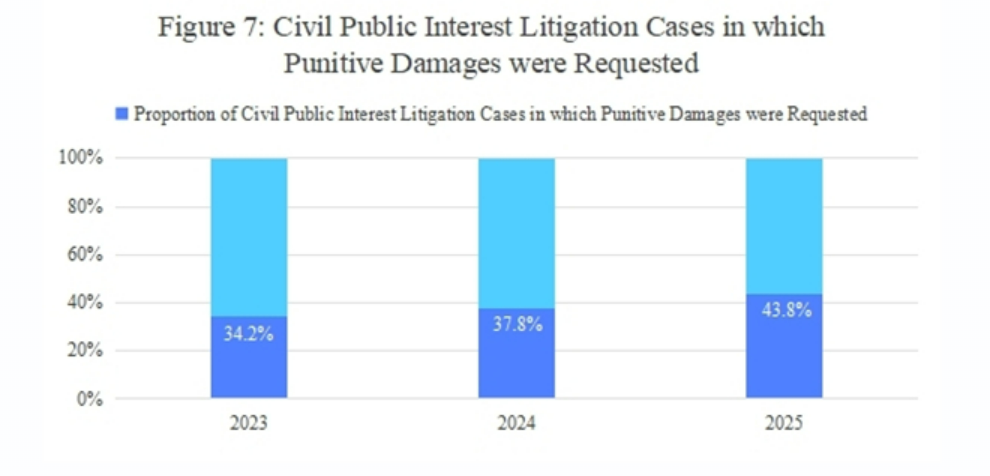
4.2 Steadily Exploring IPR Civil Public Interest Litigation. Procuratorates filed 74 civil public interest litigation cases, instituted 48 lawsuits with the people's courts, and included punitive damages claims in 21 cases, accounting for 43.8% of the total civil public interest litigation lawsuits filed. We decided to support civil public interest litigation in 4 cases.
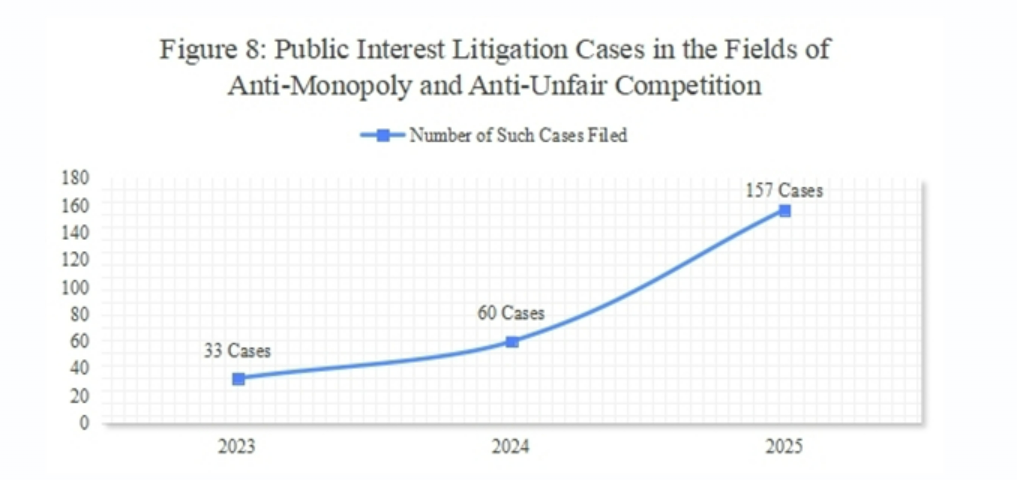
4.3 Strengthening Supervision over Anti-Monopoly and Anti-Unfair Competition. Procuratorates filed 157 public interest litigation cases in the fields of anti-monopoly and anti-unfair competition, a year-on-year increase of 1.6 times. Among these, 31 cases were in the anti-monopoly field and 126 cases were in the anti-unfair competition field.
II. Focusing on the Core Mission, Serving High-Quality Economic and Social Development
Procuratorates at all levels fully and legally exercised their IPR-related procuratorial functions in accordance with the law, continuously enhanced the quality and effectiveness of procuratorial supervision, effectively safeguarded judicial fairness, continuously optimized the innovation and business environment, and supported high-quality economic and social development.
1. Serving the Development of New Quality Productive Forces
1.1 Strengthening Criminal Protection in High-Tech Fields. Procuratorates focused on emerging and future industries such as new-generation information technology, artificial intelligence, new energy, high-end equipment, and biomedicine, strengthened criminal judicial protection of corporate original innovation and key core technology IPR, thereby creating a favorable legal environment for accelerating the achievement of high-level technological self-reliance and strength. In response to the rising incidence and complexity of trade secret infringement cases, procuratorates strengthened guidance and coordination to subordinate organs. In 2025, procuratorates nationwide accepted 114 cases involving 271 suspects for trade secret infringement for prosecutorial review and prosecuted 159 individuals. The SPP guided procuratorates in Shanghai in handling the case of Zhang X and 13 others infringing on chip technology trade secrets, where the valuation of over 40 items of technical information reached RMB 317 million (all currencies mentioned herein refer to RMB). The procuratorates accurately determined the legal nature of the case and lawfully punished the illegal acquisition and use of the rights holder's core technical secrets. All defendants were sentenced to fixed-term imprisonment; the principal offender, Zhang X, received a six-year sentence. Procuratorates in Zhejiang handled the case of Zhang X for illegally providing trade secrets to foreign entities. The defendant, Zhang X, a former employee of a well-known domestic semiconductor company, violated confidentiality obligations after leaving the company and illegally disclosed trade secrets of his former employer to a foreign organization. He was prosecuted and sentenced to imprisonment. Procuratorates in Guangdong handled the copyright infringement case of Xie X and another. Through strengthened guidance on evidence collection and rigorous evidence review, they accurately determined that the defendants' development and provision of a crack plug-in for a "3D Reconstruction Smart Mapping Software" constituted intentional circumvention of technical protection measures taken by the rights holder. The defendants were prosecuted for copyright infringement, and both were sentenced to fixed-term imprisonment.
1.2 Strengthening Legal Supervision to Ensure Uniform Legal Standards. Procuratorates comprehensively exercised their IPR procuratorial functions, continuously strengthening civil and administrative procuratorial supervision over technology-related cases involving patents, integrated circuit layout designs, new plant varieties, and computer software. We strengthened the review of the basis of rights in technology-related cases, conducted investigations and verifications in accordance with the law and in a proactive manner, and fully utilized the technical assistance system to enhance the quality and efficiency of technical fact-finding. In the civil supervision case of Zhao XX v. a company concerning invention patent infringement handled by the SPP, technical expertise was fully leveraged to assist in collaborative case handling. It was legally ascertained that Zhao XX had submitted preliminary evidence establishing a high probability that the company used his patented method. Nevertheless, the court of second instance still held that Zhao XX failed to meet his burden of proof and did not grant his application for judicial appraisal, constituting an error in the application of law and procedural impropriety. The SPP filed a protest in accordance with the law, applying for expert witnesses to attend the retrial court session to demonstrate and explain the appraisal process, basis, and conclusions. Neither party objected to the expert opinion. The parties reached a settlement during the retrial, and the case was concluded through mediation and has been fully executed. In a series of civil supervision cases handled by procuratorates in Zhejiang concerning He X v. multiple merchants regarding infringement of design patents, it was found that the patent He X sought to protect had been invalidated prior to the court's judgment. He X deliberately concealed this fact during the litigation, leading the court to render erroneous judgments. By filing protests and issuing procuratorial recommendations for retrial in accordance with the law, the procuratorates secured the correction of 9 original judgments, and He X was fined by the court.
1.3 Improving Mechanisms to Better Serve Technological Innovation. Procuratorates deeply integrated into the national innovation-driven development strategy, contributing to the building of a first-class ecosystem for scientific and technological innovation and leveraging the important role of IPR as a catalyst for innovation and an accelerator for economic development. Procuratorates in different regions, in accordance with their respective functional positioning and development needs, developed distinctive models for performing their duties, thereby effectively enhancing the overall level of IPR judicial protection and the quality and efficiency of procuratorial services on a comprehensive basis. Procuratorates in Shanghai, Zhejiang, Shandong, Jilin, and other places signed collaboration framework agreements, practical problem-solving guidance, and guidelines for administrative-criminal enforcement coordination with relevant administrative and judicial authorities. By summarizing case-handling rules, specifying evidence requirements, clarifying review standards, and establishing communication mechanisms, they built a standardized system for collaborative trade secret protection. Procuratorates in Jiangsu, Chongqing, Sichuan, and other places established and refined regular liaison mechanisms with science and technology enterprises, launched "Green Channels for Enterprise-Related IPR Protection", and through mechanisms such as expedited acceptance and referral of claims, gained timely insights into the development status of high-tech enterprises and cutting-edge technologies, as well as their needs for IPR judicial protection, thereby expanding sources of legal supervision leads and shortening the rights protection cycle for rights holders. Procuratorates in Jiangsu, Guangdong, and elsewhere, addressing risks faced by Chinese enterprises going global, such as ownership disputes in cross-border technology cooperation and overseas trademark squatting, compiled and distributed "50 Suggestions for Enterprises Going Global" and "Notice on Legal Risks in IPR and Tips for Overseas IPR Risk Prevention", providing customized "Legal Toolkit" services to support enterprises in their global expansion.
2. Stimulating Cultural Innovation and Creativity
2.1 Combating Copyright Infringement Crimes in Accordance with the Law. Procuratorates responded to the needs of cultural innovation and development, continuously intensified efforts to combat crimes, strengthened copyright protection for key works such as supplementary educational materials, audiovisual works, and computer software, as well as emerging areas such as digital copyright and cultural creativity, actively addressing new challenges posed by infringement and piracy involving new technologies. Procuratorates initiated prosecution in over 30 copyright infringement cases involving popular works such as the film "Ne Zha 2" and the trendy toy "Pop Mart". The SPP, together with the National Copyright Administration and three other departments, jointly supervised the handling of 109 major infringement and piracy cases (officially designated for supervision), providing coordinated guidance to facilitate case handling. In the copyright infringement case involving Hua XX and 19 others handled by procuratorates in Shanghai, the defendants, without the authorization from the copyright holders, distributed infringing comic works via a mobile application, with an illegal business turnover of over 24 million yuan. Procuratorates accurately determined key facts such as click counts, laying a solid foundation for prosecution. In a case handled by procuratorates in Jiangsu involving the illegal printing and sale of pirated primary and secondary school textbooks, with an identified sales amount of over 32 million yuan, the procuratorates initiated public prosecution for copyright infringement and other crimes. All the four defendants were sentenced to fixed-term imprisonment. Procuratorates in Zhejiang, in collaboration with relevant departments, established a collaborative mechanism for IPR of film and television works, promoting special rectification actions and handling several copyright infringement cases involving Spring Festival Blockbusters, achieving a full-chain crackdown and effectively supporting the healthy development of the film and television cultural industry.
2.2 Actively Adapting to the Development of New Technologies to Strengthen Judicial Protection. Procuratorates focused on emerging fields such as digital copyright and artificial intelligence, strengthened research on cutting-edge issues, handled cases involving new technologies in accordance with the law and in a prudent manner, and promoted the standardized and healthy development of the cultural industry. In a copyright infringement case involving the use of an artificial intelligence generative model handled by procuratorates in Beijing, the procuratorate accurately determined that the rights holder's works were original and that the infringing images were substantially identical to the rights holder's works. The procuratorates initiated public prosecution for copyright infringement. The defendant company was fined, and four individual defendants were sentenced to fixed-term imprisonment. The case also led to the cancellation of the false copyright registration for the involved AIGC. In the "X Anime Network" copyright infringement case handled by procuratorates in Sichuan, technical investigation officers were brought in to assist in case handling, effectively helping address difficulties in establishing the identity of suspects, and understanding infringement technical principles. This helped address professional technical issues related to "Hot-Linking" in online video copyright infringement. The defendant was sentenced to fixed-term imprisonment. In the copyright infringement case of Zhang XX and 11 others handled by procuratorates in Jiangxi, with the assistance of technical investigation officers, the procuratorates accurately ascertained the specific content, function, and circumvention technical principles of the technical protection measures taken by the rights holder. The procuratorates lawfully cracked down on the novel criminal act of manufacturing and selling physical locks, network locks, and module companions used to crack software, as well as providing installation and after-sales maintenance services for profit, protecting the legitimate rights and interests of copyright holders.
2.3 Coordinating Comprehensive Judicial Protection in the Cultural Field. Procuratorates strengthened judicial protection for historical relics, time-honored brands, and intangible cultural heritage, continuously improving governance efficiency in the cultural field, and striving to build a unified, open, competitive, orderly, and innovative cultural market environment. Procuratorates in Tianjin, focusing on issues such as brand free-riding, trendjacking and false advertising that undermined the rights and interests of time-honored brands, issued procuratorial recommendations to market supervision departments, urging them to fulfill their regulatory duties in accordance with the law, guide merchants toward standardized operations, fill regulatory loopholes in time-honored brand protection, and safeguard the reputation of these brands. Procuratorates in Shaanxi strengthened IPR protection for content, creations, and derivatives related to traditional cultural resources such as intangible cultural heritage. They visited over 660 representative inheritors of intangible cultural heritage, conducting over 40 lectures and training sessions for enterprises and relevant institutions, guided the handling of 29 IPR cases related to intangible cultural heritage, and promoted the protection and inheritance of intangible cultural heritage such as Yaozhou celadon and Ansai paper-cutting. In the case of Ou XX and 6 others for printing and selling pirated supplementary educational materials handled by procuratorates in Chongqing, in response to governance challenges in the printing and publishing industry identified during case handling, they issued procuratorial recommendations to urge administrative authorities to strengthen industry supervision, while simultaneously raising public legal awareness to promote industry self-regulation.
3. Supporting the Implementation of National Brand Strategy
3.1 Combating Trademark Infringement Crimes in Accordance with the Law. Procuratorates strengthened criminal protection of trademark rights, cracked down on the full chain of manufacturing and selling counterfeit labels and goods bearing counterfeited registered trademarks, provided equal protection to domestic and foreign brands in accordance with the law, and supported the development of the brand economy. We actively adapted to new trends and characteristics of trademark infringement crimes, lawfully and prudently handled new types of cases such as electronic trademark use, counterfeiting service marks, cross-border e-commerce sales of counterfeits, and resale of refurbished goods. In the case of Zhou XX and others for producing and selling counterfeit perfumes handled by procuratorates in Guangdong, involving 52 perfume brands, the defendants sold counterfeit goods both domestically and internationally through cross-border purchasing agencies and offline channels, with an illegal business turnover of over 120 million yuan. After lawful prosecution, 21 defendants were sentenced to criminal penalties and fined a total of over 52 million yuan, and over 82 million yuan of illicit gains were recovered and losses were compensated. Procuratorates in Beijing, Shanghai, Shandong, and other places accurately applied provisions on the service mark protection in the criminal law, and handled a batch of cases involving counterfeiting service marks in fields such as theme parks, fashion shows, and home appliance repairs.
3.2 Strengthening Supervision over Civil and Administrative Litigation. Procuratorates performed their legal supervision duties in accordance with the law, strengthened supervision over civil and administrative effective judgments involving trademarks, as well as trial and enforcement activities, and effectively safeguarded the legitimate rights and interests of rights holders. We strengthened procuratorial supervision over trademark authorization and confirmation cases, promoting the unification of administrative and judicial standards. In the administrative dispute litigation case of a Chengdu X company regarding the invalidation of a trademark right, handled by the SPP, the company argued that its trademark constituted an extension registration of two previously registered trademarks, and that the disputed trademark did not infringe upon the prior firm name rights of another company. The procuratorate reviewed these claims and found them reasonable, filed a protest in accordance with the law, and secured a reversed judgment upon retrial. In a civil trial supervision case involving trademark infringement handled by procuratorates in Liaoning, four elderly individuals were sued for trademark infringement. The procuratorates fully exercised their investigatory powers and discovered that others had illegally collected the elderly individuals' identity information to register online stores and sell counterfeit gas stoves of a certain company. They coordinated with the local procuratorates across provinces, transferred suspected criminal leads to public security organs, and the 4 civil cases were concluded with the plaintiffs withdrawing their lawsuits.
3.3 Strengthening Judicial Protection of Geographical Indication Products. Procuratorates combated crimes related to counterfeiting geographical indication products in accordance with the law, strengthened judicial protection of public interest in geographical indications, safeguarded the "Golden Signboards" and "Bright Business Cards" of local economic development, and served the implementation of the rural revitalization strategy. In 2025, procuratorates at all levels initiated 70 public interest litigations concerning geographical indications, thereby promoting the implementation of geographical indication protection. Procuratorates in Beijing discovered in the course of case handling that some IP agency institutions had submitted false testing agreements during the application process for registering geographical indication certification marks, harming the public interest. The SPP, after investigation and verification, transferred leads to the China National Intellectual Property Administration (CNIPA). Consequently, 29 geographical indication certification marks were declared invalid according to law, and the relevant agency institutions were also heavily penalized. Procuratorates in Guizhou strengthened procuratorial protection for Fenggang Zinc Selenium Tea, urged relevant departments to improve working mechanisms, and assisted in the selection of the Fenggang Zinc Selenium Tea geographical indication protection demonstration zone as a national-level demonstration zone. Procuratorates in Shanxi improved the procuratorial protection mechanism for geographical indications such as "Datong Daylily" and "Qinzhou Yellow Millet", promoted the construction of a protection network integrating industry, academia, research, and application, and urged special actions to address the abuse of some geographical indications. Procuratorates in Tibet, Ningxia, Qinghai, and other places, based on local economic development conditions, collaborated with relevant departments to strengthen protection for geographical indications such as "Nagqu Tibetan Plateau Caterpillar Fungus", "Jingyuan Yellow Beef", and "Regong Thangka", thereby boosting the quality and upgrading of regionally distinctive brands through procuratorial services.
4. Strengthening Judicial Protection in Key Areas
4.1 Continuously Deepening the Work of "Procuratorial Protection of Livelihood". Procuratorates, based on their legal supervision functions, focused on areas affecting people's livelihood such as food and drugs, daily consumer goods, and supplementary educational materials, severely cracking down on infringement and counterfeiting crimes closely related to daily life, safeguarding the lives, health, and property of the people. Based on statutory areas for public interest litigation such as food and drug safety, we fully leveraged the advantages of comprehensive IPR procuratorial functions, protecting consumer rights and interests by digging deep into the sources of crime and initiating civil public interest litigation, thereby creating a favorable market environment. In the series of cases involving Zhang XX and others for counterfeiting registered trademarks handled by procuratorates in Hebei, the defendants sold counterfeit well-known brand monosodium glutamate, chicken essence, and other products through online platforms, distributing them to over 20 provinces and municipalities nationwide, with sales amount exceeding 1 million yuan. Procuratorates meticulously reviewed all evidence, cracking down on the entire chain of counterfeit labels and the production and sale of counterfeit goods. 21 defendants were sentenced to criminal penalties, with the principal offender sentenced to six years and six months of fixed-term imprisonment. Procuratorates in Shanxi coordinated efforts to strengthen procuratorial protection for aged vinegar intellectual property. They lawfully punished crimes of counterfeiting aged vinegar, handled 8 criminal cases with incidental civil public interest litigation, and sought punitive damages of over 3.5 million yuan.
4.2 Continuously Advancing Comprehensive Cyberspace Governance. Procuratorates focused on IPR protection in emerging fields and new business models such as online marketing and live-streaming e-commerce, lawfully combating IPR crimes committed through e-commerce platforms and social software, and deepening the governance of online illegal activities. We actively carried out supervision over civil and administrative litigation in cyberspace, continuously strengthening comprehensive judicial protection of IPR. Procuratorates in Fujian, in response to the rampant phenomenon of selling counterfeits through live-streaming, established a normalized working mechanism with public security organs for joint crackdown and governance of online sales of counterfeits. They collaboratively carried out special operations to combat such crimes, dismantling 36 counterfeit production and sales sites, plus 65 live-streaming platforms and online stores, with a total amount involved reaching 120 million yuan. In a civil supervision case involving a dispute over the right to network dissemination of information in a university digital library handled by procuratorates in Beijing, procuratorial technology was used to assist in case handling. It was legally determined that the university involved only provided links to third-party digital resources, did not store the disputed works on its local server, and had fulfilled its duty of reasonable care. Therefore, it should not bear joint infringement liability for the third-party database's unauthorized uploading of infringing works. Through retrial procuratorial recommendations and other measures, the procuratorate secured the correction of 20 original judgments.
4.3 Solidly Advancing Judicial Protection in Agriculture-Related Fields. Procuratorates accurately identified the judicial needs in serving all-around rural revitalization. Focusing on key areas such as germplasm resources, agricultural inputs, and agricultural machinery, we cracked down severely on crimes such as using counterfeit labeling of seeds and producing and selling counterfeit and substandard seeds that severely endanger food security and harm farmers. Strengthened judicial protection of new plant variety rights and trade secrets in the seed industry, effectively safeguarding national seed and food security. In the trade secret infringement case involving a technology company and Wen XX and three others handled by procuratorates in Shandong, the defendants violated their confidentiality obligations by illegally disclosing technical information related to the herbicide project "Sulfentrazone", causing losses of over 8 million yuan to the rights holder. The procuratorates initiated public prosecution for trade secret infringement, ensuring that the rights holder filed an incidental civil action and received compensation of over 8 million yuan. This strengthened the protection of agricultural scientific and technological achievements. While handling criminal cases, procuratorates in Heilongjiang discovered that two companies were illegally selling "White Package Seeds" (unlabeled seeds), severely disrupting the normal production and operation order of the seed market and harming public interest. The procuratorates issued procuratorial recommendations to the competent authorities, promoting special seed enforcement inspections, effectively enhancing local seed industry IPR protection. Procuratorates in Jilin, Henan, Yunnan, Gansu, and other places, together with relevant departments such as the agriculture and rural affairs bureaus, jointly issued opinions to establish a normalized collaboration mechanism for protecting characteristic agricultural industries, enhancing the interconnection of information on agricultural crime leads, law enforcement and judicial standards, and case handling data, thereby achieving effective alignment between agricultural administrative law enforcement and criminal justice.
5. Fostering a Law-Based Business Environment
5.1 Deepening Supervision over Malicious IP Litigation. Procuratorates regularly carried out special supervision over malicious IP litigation, actively participating in the joint governance of prominent issues such as malicious trademark squatting, hoarding, and abuse of litigation rights. We leveraged digital prosecution to enhance efficiency, developing and applying a number of big data legal supervision models for IPR, efficiently uncovering supervision leads from individual cases to broader patterns, thereby promoting the extension from individual case handling to systematic supervision and governance. The SPP, in collaboration with the CNIPA and other departments, carried out a special rectification campaign in the IP agency industry. Procuratorates in Beijing and Shandong, using big data legal supervision models, discovered that a certain company, knowing that its rights to certain audiovisual works were flawed, had filed copyright infringement lawsuits in multiple local courts, suspected of malicious litigation. The SPP organized the referral and supervision of these cases, designating them for prioritized supervision and handling, coordinating integrated civil supervision across more than 10 provinces. In a case involving copyright-related false litigation handled by the Henan and Anhui procuratorates, the defendants produced vector graphics of relevant patterns through tracing and clipping, forged work publication statements, fraudulently obtained copyright registrations, and then filed infringement lawsuits to seek illegitimate benefits. Procuratorates prosecuted six defendants for the crime of fraud, and secured guilty verdicts. The SPP organized supervision over relevant effective civil judgments in more than 10 provinces.
5.2 Strengthening Judicial Guarantees for Fair Competition in Accordance with the Law. Procuratorates focused on areas prone to monopoly and unfair competition, strengthened procuratorial supervision in important sectors concerning people's livelihoods and key aspects of market competition rules, maintained a fair competitive market environment and served the construction of a national unified market. Procuratorates in Shandong strengthened the application of the anti-monopoly administrative enforcement and judicial connection and cooperation mechanism established with courts and market supervision departments. In response to a medical device company's practice of providing medical equipment to township hospitals for free while bundling the sale of reagents and consumables to gain business opportunities and competitive advantages, and restricting fair competition for suppliers of similar consumables, the procuratorate issued a procuratorial recommendation to the administrative authorities in accordance with the law, urging them to impose administrative penalties on 10 involved enterprises, helping to promote the healthy development of the medical and health industry. Procuratorates in Fujian, in response to a local administrative authority's practice of setting unreasonable access conditions during the approval process for forest logging permits—thereby effectively forcing business entities to accept designated logging survey and design services, constituting a restriction of competition—issued a procuratorial recommendation urging the administrative department to strictly implement the market access system for forest logging in accordance with the law, and followed up to verify and evaluate the effectiveness of the rectification, contributing to a fair and orderly market competition environment.
5.3 Solidly Advancing Special Supervision over Illicit Cross-Regional and Profit-Driven Law Enforcement. Procuratorates focused on prominent issues in law enforcement and judicial activities, with emphasis on supervising and correcting issues such as cross-regional law enforcement and profit-driven enforcement, and using criminal measures to intervene in economic disputes in IPR cases. Through various means such as supervision and referral, record-filing review, and strengthened guidance, we resolutely curbed illicit cross-regional and profit-driven law enforcement. Procuratorates in Jiangsu established a "Three Mandatory Reviews" mechanism: mandatory review of cases involving property compulsory measures against enterprises, mandatory review of cross-regional enforcement cases, and mandatory review of cases with repeated enterprise complaints. They also established a "Dual Early-Involvement" mechanism with public security organs: early involvement in the initial investigation phase of IPR cases and early review of cross-regional law enforcement and proposed compulsory measures, with focused supervision on illegal "Seizure, Detention, and Freezing" practices. Procuratorates in a certain province, when handling an enterprise-related case of copyright infringement of musical works, decided not to prosecute the involved company and two individual suspects. They supervised the unfreezing of funds that had been improperly frozen, and transferred leads on violations of laws and disciplines to relevant departments for handling.
5.4 Employing Multiple Measures to Resolve Conflicts and Promote Social Harmony. Procuratorates actively carried out special initiatives such as "Resolving Conflicts and Risks to Maintain Social Stability". We strengthened the recovery of illicit gains and compensation for losses through various means, including enhanced legal reasoning, encouraging infringers to actively compensate, and exploring incidental civil actions in criminal IPR cases, improving the diversified mechanism for resolving conflicts and disputes. In a civil supervision case involving a computer software contract dispute handled by the SPP, after legally filing a protest, the SPP coordinated with the Supreme People's Court (SPC) to organize on-site mediation, facilitating a settlement between the parties that was immediately executed, resolving a decade-long dispute. Procuratorates in Zhejiang, in collaboration with market regulation and other functional departments, introduced professional mediation forces such as people's mediation committees, rapid IPR protection centers, and industry associations, establishing a distinctive diversified dispute resolution platform. Through efforts to facilitate compensation, they helped 410 enterprises obtain over 210 million yuan in compensation and ensured that rights holders filed 226 incidental civil actions in criminal cases. While handling a trade secret infringement criminal case involving a technology enterprise, procuratorates solidified the chain of evidence, accurately determined the facts of the crime, encouraged the defendants to voluntarily plead guilty and accept punishment, and facilitated the infringing party to pay over 58 million yuan in compensation, resolving related civil disputes in a comprehensive manner.
III. Coordinating Efforts to Build an Overall IPR Protection Framework
Procuratorates at all levels adopted a systematic approach, upheld the rule of law, and focused on strengthening foundational work. By improving institutional supply, deepening inter-departmental collaboration, and strengthening foreign-related IPR protection, we actively promoted the development of a comprehensive IPR protection system and enhanced the overall effectiveness of IPR protection efforts.
1. Promoting the Improvement of a Coordinated IPR Protection System
Procuratorates focused on strengthening communication and collaboration with relevant departments to consolidate synergy in IPR protection. The SPP actively participated in the formulation or revision of IPR-related laws and regulations such as the Anti-Unfair Competition Law, the Trademark Law, and the Regulations on the Protection of Integrated Circuit Layout Designs, offering opinions and suggestions to promote the establishment of a more scientific, comprehensive, and effective legal system for IPR. It worked with the SPC to develop and issue Interpretation of Several Issues Concerning the Specific Application of Law in the Handling of Criminal Cases Involving Infringements upon Intellectual Property Rights, clarifying conviction and sentencing standards, unifying judicial case-handling criteria, and strengthening criminal judicial protection of IPR. The SPP also cooperated with relevant departments to advance pilot programs for the protection of trade secrets and data IPR. Procuratorates, based on local conditions, actively explored models for coordinated IPR protection and established a series of effective institutional mechanisms. Procuratorates in Tianjin jointly built a mechanism with courts for the coordinated governance of malicious litigation, forming a model of "Lead Reporting + Similar Case Retrieval + Joint Consultation + Risk Alert". Procuratorates in Heilongjiang signed opinions with the Provincial Intellectual Property Office and other departments on deepening collaborative IPR protection and establishing an anti-monopoly law enforcement and judicial coordination mechanism. Procuratorates in Hubei signed a cooperation framework agreement with the Patent Examination Cooperation Center and the Provincial Intellectual Property Protection Center to synergistically improve the quality and efficiency of handling high-tech cases. Procuratorates in Guangxi focused on key links connecting judicial protection and administrative protection of copyright, promoting seven departments to sign a collaborative protection opinion. Procuratorates in Hunan developed a manual on reviewing administrative penalties for IPR infringement by category, clarifying key points for reverse connection work, and strictly adhering to the principle of "accountability".
2. Establishing and Improving a Cross-Regional Procuratorial Protection System
Procuratorates upheld the concept of collaborative governance, strengthened integrated performance of duties, and actively built a cross-regional procuratorial protection system for IPR. Higher-level procuratorates strengthened overall guidance, focusing on key aspects such as lead transfer, communication and liaison, talent exchange, case-handling assistance, and asset recovery and loss compensation. We established collaboration mechanisms, strengthened cross-regional complementarity of strengths, and enhanced the systematic, precise, and effective nature of legal services, striving to build a multi-participant, coordinated, and efficient IPR governance system. Procuratorates in the Beijing-Tianjin-Hebei region deepened the implementation of "Three Mandatory" mechanisms covering the review, lawful transfer, verification, and feedback of leads from upstream and downstream. In 2025, they facilitated 161 collaborative cases, prosecuted 293 individuals, and added 14 individuals to prosecution, forming a joint force to combat IPR infringement crimes across the three regions. Procuratorates in Shanghai, Jiangsu, Zhejiang, and Anhui implemented institutional documents such as the IPR Procuratorial Protection Collaboration Mechanism for the Yangtze River Delta Ecological Green Integration Demonstration Zone, the Framework Agreement on Digital Economy IPR Protection, and the Collaboration Opinions on Trade Secret Protection, improving cross-regional procuratorial case-handling collaboration mechanisms. Procuratorates in Gansu led two local procuratorates in signing a framework agreement to establish a cross-regional procuratorial collaboration mechanism, effectively strengthening the judicial protection of IPR related to the cultural heritage of the Mogao Caves in Dunhuang and the Maiji Mountain Grottoes in Tianshui.
3. Actively Building a Foreign-Related Procuratorial Work System
Procuratorates actively integrated themselves into the overarching framework of foreign-related rule of law coordination, strengthened foreign-related procuratorial work, provided equal protection for the lawful rights and interests of Chinese and foreign parties in accordance with the law, and facilitated and guaranteed high-level opening-up. We promoted the improvement of the procuratorial supervision mechanism for foreign-related IPR cases and lawfully handled cases involving the protection of IPR of foreign-invested enterprises in China. We deeply participated in international exchanges and cooperation on IPR, actively took part in multilateral and bilateral IPR dialogues and international forums, including those between China and the EU, China and Russia, China and Japan, and proactively engaged in the formulation of international IPR governance rules. We strengthened communication and exchanges with international organizations such as the World Intellectual Property Organization (WIPO) and the International Trademark Association (INTA), inviting delegations of prosecutors from relevant countries to visit China for training, effectively showcasing China's achievements in IPR judicial protection and procuratorial experience. Procuratorates in Zhejiang handled over 140 criminal cases involving the infringement of IPR of foreign-invested enterprises, fully ensuring the substantive participation of rights holders in litigation, providing necessary support for overseas enterprises to file incidental civil actions in accordance with Chinese law, and actively facilitating compensation by infringers, thereby effectively enhancing the level of foreign-related IPR protection. Procuratorates in Jiangsu, Henan, Shandong, and other places lawfully protected the IPR of foreign rights holders, initiated public prosecution against trademark infringement crimes, made efforts to recover losses, and secured economic compensation for enterprises, receiving personal thanks from rights holders. Procuratorates in Shanghai and Shaanxi released bilingual (Chinese-English) White Paper on Intellectual Property Prosecution Work, demonstrating the transparency, openness, and international perspective of IPR judicial protection. Procuratorates in Beijing and Shanghai developed English-language IPR protection courses, providing training for WIPO summer schools and master's programs in China. Procuratorates in Guangdong, Hainan, Heilongjiang, Xinjiang, and other places strengthened research and practice on foreign-related rule of law, explored effective alignment between domestic and international rules, provided legal protection for domestic enterprises "Going Global", and effectively served and safeguarded the high-quality development of the Belt and Road Initiative, the construction of pilot free trade zones, and other related developments.
IV. Consolidating and Further Deepening Comprehensive Procuratorial Performance
Procuratorates at all levels continuously deepened the comprehensive performance of IPR procuratorial functions, constantly strengthened the development of case-handling organizations, talent teams, and working mechanisms, and promoted the continuous improvement of performance effectiveness through specialized IPR procuratorial development.
1. Deepening Comprehensive Procuratorial Performance and Consolidating the Foundation for High-Quality and Efficient Case Handling
The SPP formally established the Intellectual Property Procuratorial Department. Guided by this, procuratorates at all levels continuously strengthened the development of specialized IPR procuratorial institutions and case-handling organizations. Provincial procuratorates of Beijing, Zhejiang, Hubei, and Inner Mongolia, and other regions, with approval, formally established IPR procuratorial departments, optimized functional allocations, assigned specialized personnel, and continuously consolidated the comprehensive performance system. Procuratorates deepened the case-handling mechanism of "Four Reviews in One Case" (reviewing criminal, civil, administrative, and public interest litigation elements in a single IPR case), solidly advancing comprehensive IPR procuratorial protection. We handled 3,658 cases of civil, administrative, and public interest litigation procuratorial supervision, steadily improving the quality and efficiency of comprehensive performance. In a civil supervision case involving an internet domain name handled by procuratorates in Beijing, upon review, the procuratorates discovered a clue that a perpetrator had stolen the domain name. They transferred the case to the public security organs for filing and investigation, initiated a public prosecution for theft, and the defendant was sentenced to fixed-term imprisonment, thereby achieving coordinated criminal and civil protection of the domain name.
Focusing on the technology-intensive nature of IPR cases, procuratorates strengthened the support system for comprehensive performance. The SPP formulated a management measure for technical investigation officers and appointed the first group of 60 technical investigation officers covering key technology fields such as mechanics, chemistry, biology, medicine, and electronic communication. It guided local procuratorates to establish and improve systems for technical investigation officers, specially invited assistant prosecutors, expert argumentation, and other case-handling support mechanisms, providing professional support for case handling and enhancing the capacity to handle complex technology-related cases. In a criminal case of illegal securities business handled by procuratorates in Shanghai, they comprehensively utilized technical investigation officers to assist in electronic evidence review, entrusted third-party appraisal institutions to perform technical decoupling and simulation experiments, and accurately determined that the software used by the defendants had the effect of circumventing the technical measures taken by the rights holder for its software. They guided the public security organs to supplement the investigation and improve the evidence, legally added a charge of copyright infringement, and secured a guilty verdict. In a trade secret infringement case handled by procuratorates in Zhejiang, they explored a "Technology + Business" collaborative case-handling model, integrating internal and external professional technical resources, strengthening the review and use of technical evidence, and providing professional support for resolving difficult issues such as the analysis of "Non-Public Knowledge" of technical information, determination of the nature of criminal means and acts, and calculation of the amount of losses.
2. Implementing the Strategy of Strengthening Procuratorial Work through Talent and Advancing Specialized Team Capacity Building
Closely following the needs of IPR judicial protection in the new era, procuratorates actively built a specialized IPR procuratorial development system covering talent selection, training, utilization, and motivation. The SPP held three sessions of the National Special Training Course on Comprehensive IPR Procuratorial Performance, achieving full rotation training for key procuratorial personnel. It organized the Second National Essay Competition on IPR Procuratorial Theory and Practice, then selected 133 excellent papers, which promoted the integration of theoretical research and case-handling practice. The SPP intensified business guidance, improving the overall standard of the team through measures such as case supervision, model case guidance, expert lectures, and counterpart assistance between eastern and western regions. It strengthened positive incentives, guiding 6 IPR cases to be selected as national excellent arrest review cases and public prosecution cases. The SPP, together with the CNIPA and other departments, jointly commended collectives and individuals that achieved outstanding results in IPR protection in 2024; 25 collectives and 50 individuals from the procuratorial system nationwide were selected. It compiled and recommended the copyright protection experience of the Beijing procuratorates, which won the China Copyright Gold Award jointly awarded by the National Copyright Administration and WIPO. Effective practices of procuratorates in various regions were selected as typical cases for advancing the development of a strong IPR and copyright sector, as well as the in-depth integration of Party building and core business work, fostering a robust atmosphere of striving for excellence.
Procuratorates, based on their regional locations and case characteristics, continuously deepened talent cultivation, nurturing specialized personnel with both legal expertise and technical competence. Procuratorates in Shanghai, Jiangsu, Zhejiang, and Anhui organized a joint training program in the Yangtze River Delta region, striving to achieve common understanding, shared experience, and joint talent cultivation in regional IPR procuratorial work. Procuratorates in Shandong established a provincial-level IPR procuratorial talent pool, improved the full-chain mechanism for "Selection, Cultivation, Management, and Utilization", coordinated the allocation of professional case-handling forces across the province, and promoted the tiered and categorized training of young backbone and leading talents, continuously expanding the ranks of specialized IPR procuratorial personnel. Procuratorates in Sichuan carried out practical combat training of "Prosecutors Teaching Prosecutors", relying on the industrial advantages of the Chengdu-Chongqing economic circle and science and technology cities, focusing on practical training in areas such as digital IP, trade secrets, and protection of cutting-edge scientific and technological achievements.
3. Carrying out Diverse Legal Publicity and Education, Telling the Story of Procuratorial Work in the New Era
Procuratorates strictly implemented the "Who Enforces, Who Publicizes" responsibility system for legal education, deeply explored the distinctive highlights of IPR procuratorial work, adopted multiple measures to build an IPR procuratorial publicity matrix, and promoted the three-dimensional dissemination, diverse presentation, and vivid narrative of IPR procuratorial practice. The SPP held a press conference during the National IP Publicity Week on the theme of "Serving High-Level Scientific and Technological Innovation with High-Quality and Efficient IPR Procuratorial Performance", releasing the "White Paper on Intellectual Property Prosecution Work (2024)" and typical cases of IPR protection by procuratorial organs. Together with the SPC, it held a press conference to release judicial interpretations on IPR criminal cases and nine typical cases of criminal IPR protection. It guided the Shandong procuratorial authorities to produce and submit the video "Battle of Secrets", which was selected as an excellent case-handling story in the "Fifth Procuratorial Story Collection". Local procuratorates carried out various publicity activities with distinctive themes, rich content, and diverse forms through press conferences, procuratorial open days, symposiums, as well as the production of comics, short videos, and micro-films, creating a strong social atmosphere of respect for knowledge and advocacy for innovation.
Focusing on the needs of enterprises for IPR judicial protection, procuratorates deepened service measures, providing strong legal protection for enterprise innovation and development through legal education, prosecutor lectures, and other means. Procuratorates in Liaoning innovatively created a "1234 Service Model for IPR Judicial Protection and Risk Prevention," establishing an integrated service platform for IPR protection, setting up two service windows for "Multi-Dimensional Risk Prevention and Control" and "Procuratorate-Enterprise Fast-Track Service", forming a professional legal publicity team to regularly carry out "law-to-enterprise" services, conduct legal health checks, and provide customized legal publicity. They served over 1,000 enterprises in total, achieving a shift from "Enterprises Seeking Services" to "Procuratorates Proactively Delivering Services". Procuratorates in Jiangxi improved the procuratorial contact mechanism for industrial parks and chambers of commerce, facilitated point-to-point communication and liaison channels, efficiently handled enterprise complaints and rights protection claims, delivered IPR judicial services to the "doorstep" of enterprises, and effectively safeguarded enterprise innovation and development. Procuratorates in Shanghai continuously improved the mechanism of "Deputy Legal Director" for science and technology innovation parks, coordinated with 30 national and municipal-level science and technology innovation parks with clusters of key industries, including the Lin-gang Special Area of China (Shanghai) Pilot Free Trade Zone, Zhangjiang Science City, and the "Model Space", conducting over 250 legal activities such as consulting services and lead analysis. Procuratorates in Shaanxi established the Qinchuangyuan IPR Procuratorial Protection Center, simultaneously promoting 10 municipal-level and 76 grassroots-level procuratorates to establish and improve enterprise contact and service mechanisms. They collected over 210 relevant leads and handled over 230 cases.
Conclusion
The year 2026 marks the beginning of the 15th Five-Year Plan period. It is also a crucial year for intellectual property procuratorial work to serve the overall national development and achieve leapfrog progress.
Guided by Xi Jinping Thought on Socialism with Chinese Characteristics for a New Era, procuratorates will fully implement the guiding principles of the 20th CPC National Congress and all plenary sessions of the 20th Central Committee, thoroughly practice the "Three Proficiencies" requirement, and advance the "Three Types of Governance" in an integrated way.
We will focus on developing the "Five Major Systems" for high-quality case handling, and align with the core goals of developing a country strong on intellectual property rights.
We will continue to strengthen specialized case-handling organizations and talent teams, improve working mechanisms for comprehensive procuratorial performance, and intensify punishment for crimes infringing intellectual property rights in accordance with the law.
We will comprehensively improve the quality and effectiveness of supervision over civil and administrative litigation, steadily explore public interest litigation involving intellectual property rights, and deepen supervision over malicious intellectual property litigation.
We will establish and improve coordination and cooperation mechanisms to better leverage high-quality intellectual property procuratorial performance to serve and encourage innovation and creativity, promote cultural prosperity, safeguard fair competition, and protect people's wellbeing.

 CHINA intellectual PROPERTY LAWYERS NETWORK

 +86-13910160652
 ciplawyers@163.com



 Home
Home Previous




Comment