
Note: Page 65 is blank.

The Guangzhou Intellectual Property Court ruled seven defendants liable for "virtual digital human" trade secret infring...

The Supreme People's Court ruled that patentees with valid patents and positive evaluation reports fulfill duty of care,...
Recently, a series of trademark infringement lawsuits brought by Louis Vuitton Malletier (hereinafter “Louis Vuitton”) have attracted widespread public attention. Many members of the public, as well as a considerable number of professionals, believe that Louis Vuitton’s registered four-lobed floral pattern series trademarks bear a striking resemblance to traditional Chinese shidi patterns and baoxianghua motifs. These traditional patterns have existed in China for over a thousand years and have been widely used in architecture, textiles, and artifacts. When such public cultural symbols are registered as trademarks by a single enterprise and used to sue local brands, the public naturally feels a sense of “cultural appropriation.”
It must be noted, however, that Louis Vuitton’s registration of these trademarks does not equate to an exclusive monopoly over the “four-lobed floral” design itself. In trademark infringement analysis, the core standard remains the “likelihood of confusion.” This means that even if a third party uses a design similar to Louis Vuitton’s four-lobed flower, such use does not fall within the scope of trademark rights so long as it does not cause consumer confusion as to the source of the goods. The “four-lobed flowers on public restroom decorations, bed sheets, and curtains” jokingly mentioned by netizens are precisely examples of situations not covered by trademark protection. Patterns on public restrooms and bed sheets serve a decorative or aesthetic function—such use constitutes “non-trademark use” insofar as it is not intended to indicate the source of goods, and therefore does not constitute trademark infringement.
I. The Path to Trademark Registration for Public Cultural Elements
Historically, public cultural elements have never been far from trademarks. In the early days of China’s trademark system, a large number of early trademarks were directly derived from public cultural symbols or were stylistically adapted from them. Public cultural elements themselves are public resources shared by all; their original expressions, having long since entered the public domain due to the passage of time, may be freely used and re-created by anyone.
From the perspective of trademark law, original elements generally lack “distinctiveness” because they are common decorative motifs—the public, upon seeing them, first associates them with cultural traditions rather than with commercial identifiers. Only through original transformation, such that the transformed graphics, patterns, or symbols acquire the function of indicating the source of goods—i.e., distinctiveness—may they be used as trademarks.
In practice, there are numerous examples of public cultural elements being re-created and successfully registered as trademarks:
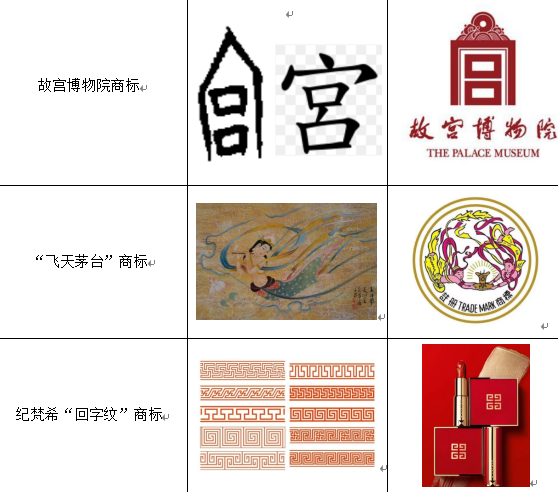
These cases gained recognition because they involved a sufficient degree of creative transformation. The Givenchy meander-pattern trademark, the Palace Museum’s cultural and creative graphic trademark, and the Moutai “Flying Apsaras” trademark are all derived from traditional Chinese motifs: Givenchy drew on the traditional huiwen pattern’s spiraling structure and transformed it into an independent geometric figure formed by interwoven letters; the Palace Museum extracted motifs from its collection of cultural relics, removed redundant details, and re-composed the composition to create original derivative graphics; Moutai’s “Flying Apsaras” drew on the Dunhuang mural flying-apsaras imagery, discarded the original mural scenes, added wine-related elements, and reshaped the figures to construct a new composition of “apsaras offering wine.”
However, owning a trademark derived from public cultural elements does not mean one may monopolize the public elements themselves. In the Dunhuang “Shoubao Long” (Guardian Dragon) trademark case, the Xiamen Intermediate People’s Court held that “Shoubao Long” was a descriptive term for the “seated dragon” in Dunhuang murals and constituted a public cultural resource; others’ use of it constituted a legitimate description of design inspiration and did not constitute infringement. This judgment demonstrates that rights holders cannot use their rights to prohibit others’ legitimate use of public cultural elements.
II. Legal Analysis of Louis Vuitton v. Molly Tea
The trademarks at issue in this dispute are Louis Vuitton’s Registration Nos. 61812517A, 68717216A, 1106302, 1111910, 1112498, 52161177, 68725763A, 59199836A, and 59199834A. According to official records, all of these trademarks are currently under invalidity review.
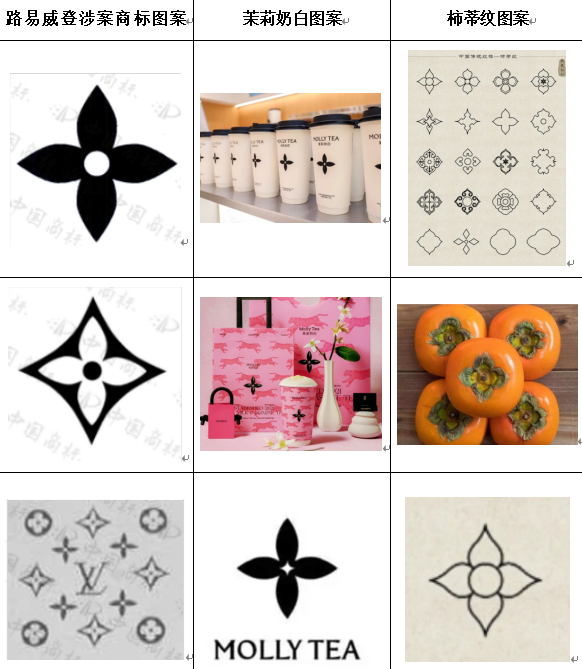
Comparing Louis Vuitton’s four-lobed clover trademark with the classic Chinese shidi pattern reveals that both patterns consist of four petals and a central circular aperture, with the petals evenly distributed along the cardinal directions. The petal contours are similar, and the overall composition, layout, and visual focal points are highly congruent. The only differences lie in minor variations in presentation—such as solid fill versus outline delineation, and the size of the central circle—but overall, no clear distinguishing features are formed. Therefore, it is difficult to conclude that the four-lobed clover trademark possesses originality relative to the traditional shidi pattern.
In this case, Louis Vuitton’s enforcement of this trademark against Molly Tea essentially requires answering whether a symbol rooted in public cultural tradition can be transformed into privately owned property through trademark registration. To answer this question, it is insufficient to discuss the technical rules internal to trademark law; one must return to the level of legal theory and seek the foundations within the logic of intellectual property.
The German jurist Samuel von Pufendorf distinguished between positive commons and negative commons, holding that in the beginning all things were held in common, and that negative commons represent a primordial state of universal accessibility. “In the beginning all things were held in common, and human beings had the right to use according to their needs those things that were offered for the free use of all men”[1]. It excluded no one, and individuals could freely take what they needed for self-preservation. Positive commons, by contrast, represent a relatively more developed concept. Pufendorf understood positive commons as a state in which “several persons” jointly own a thing; unlike private property, which belongs to one person, the rights to positive commons are shared among members of a specific group, and persons outside that group do not automatically enjoy rights to the common property. Its core feature is that any individual’s disposition or privatization of common property requires the collective consent and authorization of the group.
The Australian legal scholar Peter Drahos, in his book A Philosophy of Intellectual Property, further categorized commons into inclusive and exclusive categories—a dimension concerning the manner in which members of the commons are selected[2]. Inclusive commons have no identity threshold and are open to all, whereas exclusive commons have specific boundaries and are limited to particular groups. Crossing these two dimensions yields four forms of commons: inclusive positive commons, exclusive positive commons, inclusive negative commons, and exclusive negative commons. The subjects of both inclusive positive commons and inclusive negative commons are all of humanity. In an inclusive positive commons, any person’s use or appropriation of common property requires the consent of all humanity. An inclusive negative commons, by contrast, is one in which anyone may freely acquire and establish private property through labor without anyone’s consent. The subjects of both exclusive positive commons and exclusive negative commons are specific groups. In an exclusive positive commons, group members jointly decide how resources are to be used, and non-members are explicitly excluded. An exclusive negative commons means that the resource belongs to no one in the group, and each member of the group may freely acquire and use the resource, but those outside the group are excluded.
The shidi pattern, bearing the auspicious connotations of “all wishes fulfilled” and “smooth sailing,” traces its history back to the Warring States period and reached its peak in the Han Dynasty through subsequent absorption and evolution. These patterns, transmitted over millennia, have been widely applied within the Chinese cultural sphere to various expressive contexts, including artifact decoration, textile brocades, and architectural painting. Under Peter Drahos’s theory of the “intellectual commons,” such patterns have developed a kind of “commons agreement”: members of the Chinese cultural community are entitled to use these patterns in accordance with established cultural rules. This constitutes an exclusive positive commons, the boundaries of which are delimited by the Chinese cultural community, and non-members of that cultural sphere do not automatically enjoy the same rights of use.
Alternatively, viewed from a broader perspective, these patterns may be considered part of the “inclusive positive commons” of humanity’s decorative arts. The shidi pattern is not only a treasure of Chinese culture but also an important part of the history of human decorative art, incorporating elements of lotus, pomegranate, peony, and other plants, from which creators of any cultural background may draw inspiration.
When Louis Vuitton, a French company, slightly modifies this pattern, registers it as a trademark, and in turn sues Chinese merchants, this conduct, under Drahos’s four-fold commons framework, constitutes a profound affront to the commons order. If the baoxianghua and shidi patterns are treated as objects of the “exclusive positive commons” of the Chinese cultural community, then the rights of internal members to use these patterns derive from the commons agreement formed through the chain of cultural transmission. Louis Vuitton, however, is neither a member of the cultural community to which these patterns belong nor has it obtained the collective consent of that community, yet it has appropriated these patterns as its own.
Furthermore, if it is acknowledged that the baoxianghua and shidi patterns, as motifs of human decorative art, also possess the attributes of an “inclusive positive commons,” then Louis Vuitton’s actions constitute not only an encroachment upon the common resources of a specific cultural community, but also a privatization and enclosure of a decorative art heritage shared by all humanity. It is on this very logic that Louis Vuitton’s attempts to monopolize common decorative motifs such as chequerboard patterns through trademark rights in the EU have been repeatedly rejected.
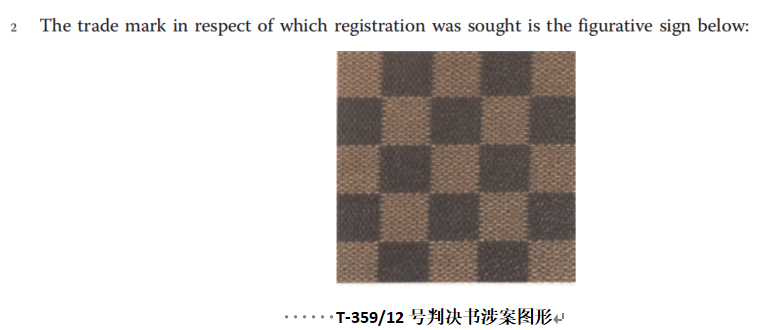
Take, for example, Louis Vuitton’s brown-and-beige chequerboard pattern case in the EU. In its judgment in Case T-359/12, the General Court of the European Union explicitly held that the chequerboard pattern itself is a “basic and commonplace figurative pattern” and lacks inherent distinctiveness[3]. The court further held that even when superimposed with a grid structure or specific color combinations, the pattern failed to produce any visual effect that significantly deviated from industry practice[4]. Moreover, the EU courts have set an extremely high threshold of proof for Louis Vuitton’s claim of having acquired “secondary meaning” through long-term use. Under the principle of unitary character of EU trade marks, for a mark to be registered throughout the EU, it must possess distinctiveness throughout the entire EU territory. The court reaffirmed in its judgment: “it is necessary to establish the acquisition of distinctive character through use in all the territory in which the mark did not, ab initio, have such character,” and “when a contested mark is devoid of any distinctive character in the European Union as a whole, the acquisition of distinctive character by that mark must be established in relation to each of the Member States.” This reasoning was reinforced in the subsequent Damier Azur (white-and-blue chequerboard) case[5].
III. Can Combined Mark Goodwill Automatically Confer Independent Distinctiveness on an Individual Graphic Element?
Furthermore, this case raises a critical question: when a graphic element appears in commercial practice as part of a composite mark and is itself derived from the public domain, can the fame of the composite mark automatically be presumed to confer independent distinctiveness and exclusive rights upon that isolated graphic element? The first-instance judgment’s reasoning on this issue exhibits a notable logical leap and doctrinal flaw.
In the “Time Zone” case before the Guangdong High Court[6], Louis Vuitton held only the complete Monogram composite mark and did not possess a separate four-lobed flower graphic registration. The court held that the four-lobed flower was merely a constituent fragment of the fabric print and did not independently perform the function of indicating the source of goods, and therefore the local elements of the composite mark could not be severed and enforced separately.
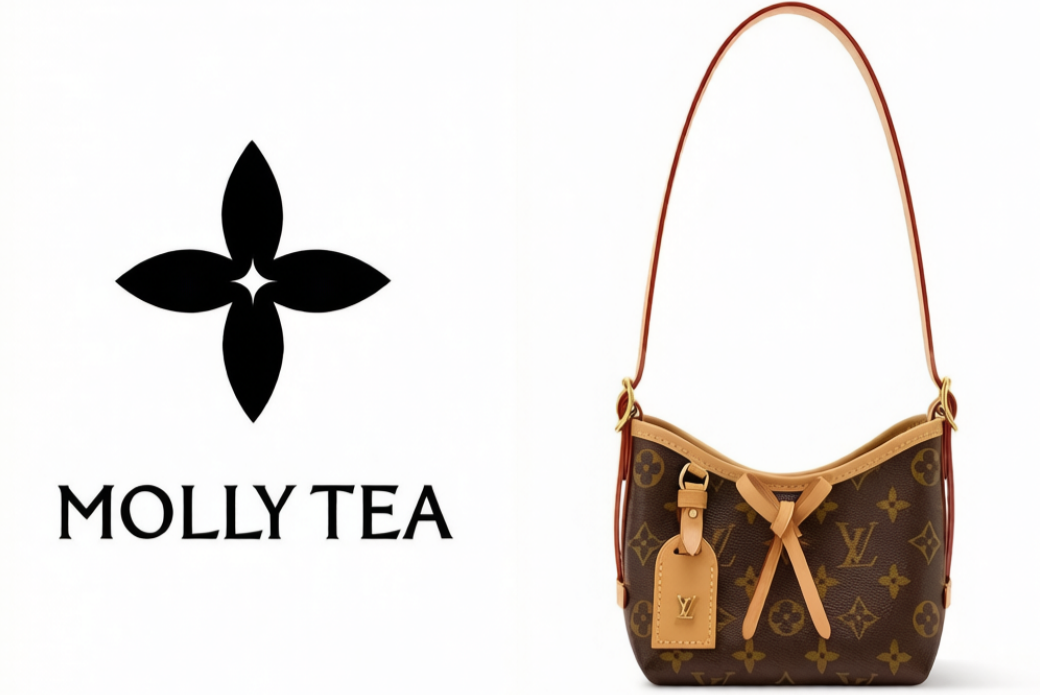
In the first-instance Louis Vuitton v. Molly Tea case[7], the plaintiff’s rights were based on seven independently registered four-lobed floral graphic trademarks. The court stated: “This four-lobed floral pattern is derived from Louis Vuitton’s Monogram composite mark and is one of the original design elements of that composite mark. With the use and acquired fame of the Monogram composite mark, the four-lobed floral mark itself has also acquired a certain degree of distinctiveness. After the registration of the marks at issue, Louis Vuitton used them in promotional and marketing activities for catering and other business operations. The marks at issue, through use, have acquired a certain degree of distinctiveness and carry consumer recognition and commercial goodwill, and can serve to distinguish the source of goods or services.” However, this reasoning is open to question on both doctrinal and factual grounds.
First, as to the inherent attributes of the mark, the four-lobed floral graphic at issue is derived from traditional Chinese ornamental motifs and falls within the category of public cultural resources; it does not possess inherent distinctiveness. In its judgment, the court referred to the pattern at issue as a “four-leaf clover pattern” and noted that “the four-leaf clover pattern is widely used in human traditional culture and modern creativity and has been endowed with various meanings such as luck, but the marks at issue have undergone detailed design, including line details, line curvature, and intersection methods, and are not simple geometric figures or simple combinations of patterns that have entered the public domain, reflecting the designer’s concepts and expressions”[8]. In reality, however, whether referred to as “four-leaf clover” or “shidi pattern,” the pattern is in essence derived from traditional Chinese decorative motifs. For a graphic that is derived from the public domain and lacks originality, the courts should be cautious in granting exclusive rights.
Second, the court simply held that “with the use and acquired fame of the Monogram composite mark, the four-lobed floral mark itself has also acquired a certain degree of distinctiveness”[9]. This inference is logically untenable. In essence, it indiscriminately attributes the entire goodwill of the composite mark to each of its constituent elements, thereby avoiding independent proof and determination as to whether the isolated graphic itself has acquired distinctiveness. If the entire Monogram composite mark is analogized to a complete “personality as a whole,” then the LV letters are the head and face of that whole—the core and soul of brand recognition—while the four-lobed flower, four-pointed star, and other constituent elements are analogous to the torso and limbs. The goodwill of the composite mark derives from the overall visual effect created by the synergy of all elements, with the core identifying power concentrated in the LV letters. If the composite mark is dismembered and its core identifying parts are stripped away, the separated torso and limbs do not form a stable corresponding relationship with Louis Vuitton and therefore lack distinctiveness.
Third, the first-instance court directly characterized decorative use as trademark use, on the ground that “the core of determining whether a mark constitutes trademark use or decorative use lies in whether the use is merely for aesthetic purposes, for decoration, or whether it enables the relevant public to distinguish the provider and specific source of goods or services through the mark. Even if the use of the mark objectively has an aesthetic effect, so long as it allows consumers to directly associate it with a specific brand, it constitutes trademark use”[10].
This reasoning fails to adequately distinguish between trademark use and decorative use. Louis Vuitton’s extensive use of this pattern derived from traditional motifs as fabric print on its products largely serves a decorative function as well—and the primary function that traditional motifs have served for millennia is precisely decoration. Therefore, when the public sees a pattern that primarily serves a decorative function and is highly similar to traditional motifs, they will not perceive it as Louis Vuitton’s commercial identifier, but will only understand it as a decorative pattern. Even if some people occasionally associate it with Louis Vuitton, that proves nothing.
Although Louis Vuitton supplemented its case with evidence of its separate use of the graphic in its cafés, it failed to further prove that, once the LV letters and star motifs are removed, the relevant public has formed a stable and independent brand recognition of the isolated four-lobed flower graphic standing alone.The vast majority of Louis Vuitton’s commercial use in the market still employs the four-lobed flower as a constituent element of the Monogram composite print, rather than as an independent LOGO used alone or prominently for brand promotion.
IV. Defensive Protection of Traditional Motifs
The predicament exposed by this case regarding the protection of traditional motif trademarks has general warning significance: the existing trademark rules lack adequate ex ante preventive mechanisms for public traditional cultural resources. The current system has obvious deficiencies—a vast number of traditional motifs remain in an unprotected vacuum state, are susceptible to registration by commercial entities, and in turn restrict the inheritance and development of local culture itself.
According to the World Intellectual Property Organization’s definition, defensive protection refers to “a set of strategies to ensure that third parties do not acquire illegitimate or unfounded intellectual property rights over traditional knowledge.” It does not seek to create new private rights for traditional cultural elements, but rather, by establishing searchable public information databases, provides examiners with “prior art evidence” during trademark examination, thereby preventing others from registering public cultural resources as private rights ab initio.
India’s Traditional Knowledge Digital Library (TKDL) is the most representative example and offers valuable reference. This project catalogued over 520,000 formulations from India’s traditional medicine systems, translated them into five international languages, and entered into confidential access agreements with patent offices of 18 countries and regions. It is reported that based on prior art evidence provided by the TKDL, more than 375 patents have been revoked, rejected, or amended globally[11].
In contrast, defensive protection of traditional motifs in China is still in its infancy. There is a disconnect between the Intangible Cultural Heritage Law and the trademark protection system, and a large number of traditional motifs scattered across murals, ancient architecture, and artifacts have long remained unprotected. Trademark applications containing traditional motifs are not required to indicate cultural provenance, and there is no official motif database for comparison during examination, making it easy for public cultural resources to be privatized through rights confirmation.
A consensus has emerged in domestic academic and practitioner circles, calling for the establishment of a national-level traditional motif database to systematically archive classic intangible cultural heritage motifs and folk patterns from all dynasties, publicly record them, and incorporate them as official prior art evidence in trademark rights confirmation and judicial adjudication. Of course, such a system must be advanced with caution. The purpose of the database should be to prevent public resources from being privatized and enclosed, not to create new exclusive rights over traditional motifs. At the same time, the construction of the database must address practical challenges such as classification standards, integration with existing examination systems, and international information sharing.
Conclusion
Trademark rights protect not the words or graphics themselves, but the goodwill and market trust accumulated through commercial use. In an era of increasing intellectual property importance, we must both respect the lawful monopolies of rights holders and remain vigilant against the improper enclosure of public resources. Only by maintaining a proper balance between trademark monopolies and the protection of traditional motifs and commons knowledge can trademark protection truly become a force for promoting innovation and cooperation, rather than a weapon for land-grabbing.
Notes
[1] S. Pufendorf, De Jure Naturae et Gentium (1672), cited in Wang Tiexiong, “Pufendorf’s Theory of Natural Property Rights,” Frontier, No. 7, 2010, pp. 66–73.
[2] Peter Drahos, A Philosophy of Intellectual Property, trans. Zhou Lin (Beijing: The Commercial Press, 2017), 90.
[3] Case T-359/12, concerning the brown-and-beige chequerboard pattern, para. 37 (“the chequerboard pattern is a basic and commonplace figurative pattern, since it is composed of a regular succession of squares of the same size which are differentiated by alternating different colours”).
[4] Case T-359/12, para. 41 (“the juxtaposition of two elements that are not in themselves distinctive cannot alter the perception of the relevant public as to the absence of distinctive character, ab initio, of the contested mark”).
[5] Case T-275/21, concerning the white-and-blue chequerboard pattern, judgment of the General Court (Tenth Chamber) of October 19, 2022, upholding the cancellation of the mark on the ground that Louis Vuitton failed to prove acquired distinctiveness throughout the EU, particularly with insufficient evidence of use in Eastern European countries such as Lithuania and Latvia.
[6] Guangdong High People's Court, (2008) Yue Gao Fa Min San Zhong Zi No. 345 Civil Judgment.
[7] Suzhou Intermediate People's Court, (2025) Su 05 Min Chu No. 617 Civil Judgment (first instance; circulated online version).
[8] Supra note [7], at 41.
[9] Supra note [7], at 42.
[10] Supra note [7], at 42.
[11] “About TKDL- Launched in 2001 by the CSIR and the Ministry of AYUSH, the ‘Traditional Knowledge Digital Library’ (CSIR-TKDL) is the world’s first database designed to protect traditional knowledge against erroneous patent claims. It contains over 5.2 lakh formulations from Indian traditional systems, translated into five international languages. Following the inclusion of IP Australia, the TKDL database is now accessible to 18 patent offices and has helped address more than 375 patent applications globally.
https://www.rajasthantribune.in/2026/07/10/csir-tkdl-access-agreement-boosts-india-australia-cooperation-on-traditional-knowledge-protection/#respond


 CHINA intellectual PROPERTY LAWYERS NETWORK

 +86-13910160652
 ciplawyers@163.com


 Home
Home




Comment